The laws of space and the birth of time

Jacob sitting in the Sala de las Camas.
Jacob Bronowski (1973). The Ascent of Man

The Sala de las Camas in hi-res.
The force imposed by our particular space

These leaves make a complete round at four right angle rotations, revealing that space itself is a rigid lattice with a fourfold symmetry.
The Arabs were fond of designs in which the dark and the light units of the pattern are identical. And so, if for a moment you ignore the colours, you can see that you could turn a dark leaf once through a right angle into the position of a neighbouring light leaf. Then, always rotating round the same point of junction, you can turn it into the next position, and (again round the same point) into the next, and finally back on itself. And the rotation spins the whole pattern correctly; every leaf in the pattern arrives at the position of another leaf, however far from the centre of rotation they lie, [revealing a fourfold symmetry.]
Reflection in a horizontal line is a twofold symmetry of the coloured pattern, and so is reflection in a vertical. But if we ignore the colours, we see that there is a fourfold symmetry. It is provided by the operation of rotating through a right angle, repeated four times, by which I earlier proved the theorem of Pythagoras; and thereby the uncoloured pattern becomes in its symmetry like the Pythagorean square.

These are the triangles, whose 60° rotations reveal an underlying lattice with a sixfold symmetry.
I turn to a much more subtle pattern. These windswept triangles in four colours display only one very straightforward kind of symmetry, in two directions. You could shift the pattern horizontally or you could shift it vertically into new, identical positions. Being windswept is not irrelevant. It is unusual to find a symmetrical system which does not allow reflection. However, this one does not, because these windswept triangles are all right-handed in movement, and you cannot reflect them without making them left-handed.
Now suppose you neglect the difference between the green, the yellow, the black, and the royal blue, and think of the distinction as simply between dark triangles and light triangles. Then there is also a symmetry of rotation. Fix your attention again on a point of junction: six triangles meet there, and they are alternately dark and light. A dark triangle can be rotated there into the position of the next dark triangle, then into the position of the next, and finally back into the original position – a threefold symmetry which rotates the whole pattern.
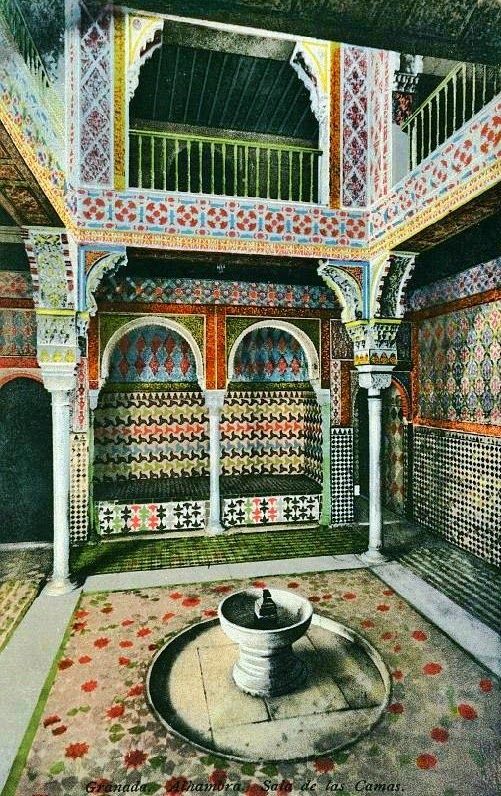
A colorized postcard, c. 1960.
And indeed the possible symmetries need not stop there. If you forget about the colours at all, then there is a lesser rotation by which you could move a dark triangle into the space of the light triangle beside it because it is identical in shape. This operation of rotation then goes on into the dark, into the light, into the dark, into the light, and finally back into the original dark triangle – a sixfold symmetry of space which rotates the whole pattern. And the sixfold symmetry in fact is the one we all know best, because it is a symmetry of the snow crystal.
At this point, the non-mathematician is entitled to ask, ‘So what? Is that what mathematics is about? Did Arab professors, do modern mathematicians, spend their time with that kind of elegant game?’ To which the unexpected answer is – Well, it is not a game. It brings us face to face with something which is hard to remember, and that is that we live in a special kind of space – three-dimensional, flat – and the properties of that space are unbreakable. In asking what operations will turn a pattern into itself, we are discovering the invisible laws that govern our space. There are only certain kinds of symmetries which our space can support, not only in man-made patterns, but in the regularities which nature herself imposes on her fundamental, atomic structures.
Space is fixed and rigid and (given our 360° convention) will house contiguous triangles rotated around a center only if the sum of their angles at the shared vertex add up to 360—no more and no less. Space will not stretch to accommodate 361° or 359°. Arranging isosceles triangles so that (1) the apex of each touches the same point, and (2) the sides of each are contiguous. Certain results follow —
- The number of tiles must be a whole number
- The angle of each apex must be exactly 360° divided by the number of tiles
- The angle of each apex cannot be > 120°
The concrete result: The tiles that will fit regularly have apexes of 120°, 90°, 72°, 60°, ≈ 51.43°, 45°, 40°, 36°, and so on.
What if we limit our experiment only to equilateral triangles? How many can fit regularly? Two? Nope. Three? Nope … wait, yes—if I push them together so that their tops pop off their home plane into an orthogonal dimension. If I hinge the triangles’ sides together while raising the shared center point up, the gaps will decrease until all sides are touching. The result will be a tetrahedron without a base. Four and five will also fit this way. And six will fit without having to lift the shared center.
But these Arabic tessellations contain not only a single rotated pattern, but an infinite pattern seamlessly fitting and repeating in all directions. This adds an additional restriction, and limits rotations to 2, 3, 4, and 6 only.
The structures that enshrine, as it were, the natural patterns of space are the crystals. And when you look at one untouched by human hand – say, iceland spar – there is a shock of surprise in realising that it is not self-evident why its faces should be regular. It is not self-evident why they should even be flat planes. This is how crystals come; we are used to their being regular and symmetrical; but why? They were not made that way by man but by nature. That flat face is the way in which the atoms had to come together – and that one, and that one. The flatness, the regularity has been forced by space on matter with the same finality as space gave the Moorish patterns their symmetries that I analysed.
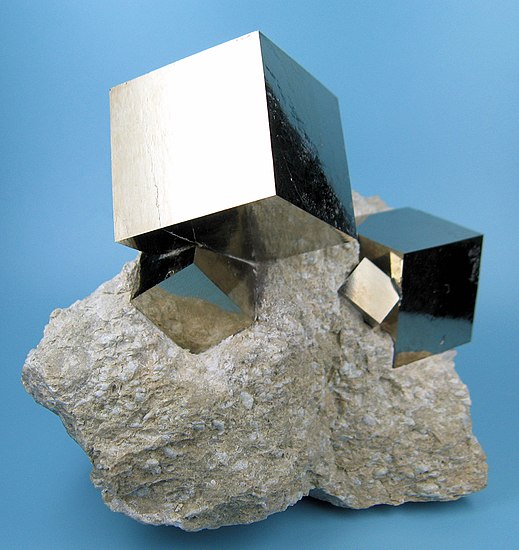
At first glance, these appear as Paley’s watches. Then you realize—while the location and orientation of the original seed crystal is accidental, once set, the perfect cube follows by necessity.
Take a beautiful cube of pyrites. Or to me the most exquisite crystal of all, fluorite, an octahedron. (It is also the natural shape 0f the diamond crystal.) Their symmetries are imposed on them by the nature of the space we live in – the three dimensions, the flatness within which we live. And no assembly of atoms can break that crucial law of nature. Like the units that compose a pattern, the atoms in a crystal are stacked in all directions. So a crystal, like a pattern, must have a shape that could extend or repeat itself in all directions indefinitely. That is why the faces of a crystal can only have certain shapes; they could not have anything but the symmetries in the patterns. For example, the only rotations that are possible go twice or four times for a full turn, or three times or six times – not more. And not five times. You cannot make an assembly of atoms to make triangles which fit into space regularly five at a time.
Triangles, triangles, triangles—why are these the important planar figure? First, because it is the simplest. Triangles are the elementary figures from which all others can be composed. (And for this reason, 3-D rendering software decomposes smooth surfaces into a wireframe of triangles.) But Jacob is only concerning himself with equilateral triangles here. This is the dream—to find the solids that we can construct from the polygon that is both the simplest (3 sided) and symmetrical (equilateral). And it turns out that the perfect 2-D figure generates three Platonic Solids—tetrahedron, octahedron, and dodecahedron. Three out of the five Platonic Solids have triangles as their faces.
Plato’s most admirable and reasonable inference about the occult realm of physics was his conjecture that all the many varieties of physical object arise from permutations of (very) large numbers of elements of only a few types—these being regular polyhedrons whose faces are all regular polygons. On the macro scale, things are irregular, interesting, and full of surprises. But the tinies that constitute them are limited to only five types. Which five? We see Plato’s parsimony in his answer—the faces of each elemental solid must all be the same.
You can run the experiment yourself —
- I give you stacks of regular n-gon tiles, from triangles up to chiliagons.
- For each type of n-gon, arrange tiles together such that (1) all edges are contiguous and (2) the polygons come to enclose a volume. We find that only five such polyhedra are possible, and that only three polygons will work—triangle, square, and hexagon.
Thinking about these forms of pattern, exhausting in practice the possibilities of the symmetries of space (at least in two dimensions), was the great achievement of Arab mathematics. And it has a wonderful finality, a thousand years old. The king, the naked women, the eunuchs and the blind musicians made a marvellous formal pattern in which the exploration of what exists was perfect, but which, alas, was not looking for any change. There is nothing new in mathematics, because there is nothing new in human thought, until the ascent of man moved forward to a different dynamic.
Perspective and the spatialization of time
Christianity began to surge back in northern Spain about AD 1000 from footholds like the village of Santillana in a coastal strip which the Moors never conquered. It is a religion of the earth there, expressed in the simple images of the village – the ox, the ass, the Lamb of God. The animal images would be unthinkable in Moslem worship. And not only the animal form is allowed; the Son of God is a child, His mother is a woman and is the object of personal worship. When the Virgin is carried in procession, we are in a different universe of vision: not of abstract patterns, but of abounding and irrepressible life.
When Christianity came to win back Spain, the excitement of the struggle was on the frontier. Here Moors and Christians, and Jews too, mingled and made an extraordinary culture of different faiths. In 1085 the centre of this mixed culture was fixed for a time in the city of Toledo. Toledo was the intellectual port of entry into Christian Europe of all the classics that the Arabs had brought together from Greece, from the Middle East, from Asia.
We think of Italy as the birthplace of the Renaissance. But the conception was in Spain in the twelfth century, and it is symbolised and expressed by the famous school of translators at Toledo, where the ancient texts were turned from Greek (which Europe had forgotten) through Arabic and Hebrew into Latin. In Toledo, amid other intellectual advances, an early set of astronomical tables was drawn up, as an encyclopedia of star positions. It is characteristic of the city and the time that the tables are Christian, but the numerals are Arabic, and are by now recognisably modern.
The most famous of the translators and the most brilliant was Gerard of Cremona, who had come from Italy specifically to find a copy of Ptolemy’s book of astronomy, the Almagest, and who stayed on in Toledo to translate Archimedes, Hippocrates, Galen, Euclid – the classics of Greek science.
And yet, to me personally, the most remarkable and, in the long run, the most influential man who was translated was not a Greek. That is because I am interested in the perception of objects in space. And that was a subject about which the Greeks were totally wrong. It was understood for the first time about the year AD 1000 by an eccentric mathematician whom we call Alhazen, who was the one really original scientific mind that Arab culture produced. The Greeks had thought that light goes from the eyes to the object. Alhazen first recognised that we see an object because each point of it directs and reflects a ray into the eye. The Greek view could not explain how an object, my hand say, seems to change size when it moves. In Alhazen’s account it is clear that the cone of rays that comes from the outline and shape of my hand grows narrower as I move my hand away from you. As I move it towards you, the cone of rays that enters your eye becomes larger and subtends a larger angle. And that, and only that, accounts for the difference in size. It is so simple a notion that it is astonishing that scientists paid almost no attention to it (Roger Bacon is an exception) for six hundred years. But artists attended to it long before that, and in a practical way. The concept of the cone of rays from object to the eye becomes the foundation of perspective. And perspective is the new idea which now revivifies mathematics.
The excitement of perspective passed into art in north Italy, in Florence and Venice, in the fifteenth century. A manuscript of Alhazen’s Optics in translation in the Vatican Library in Rome is annotated by Lorenzo Ghiberti, who made the famous bronze perspectives for the doors of the Baptistry in Florence. He was not the first pioneer of perspective – that may have been Filippo Brunelleschi – and there were enough of them to form an identifiable school of the Perspectivi. It was a school of thought, for its aim was not simply to make the figures lifelike, but to create the sense of their movement in space.
The movement is evident as soon as we contrast a work by the Perspectivi with an earlier one. Carpaccio’s painting of St Ursula leaving a vaguely Venetian port was painted in 1495. The obvious effect is to give to visual space a third dimension, just as the ear about this time hears another depth and dimension in the new harmonies in European music. But the ultimate effect is not so much depth as movement. Like the new music, the picture and its inhabitants are mobile. Above all, we feel that the painter’s eye is on the move.
Contrast a fresco of Florence painted a hundred years earlier, about AD 1350. It is a view of the city from outside the walls, and the painter looks naively over the walls and the tops of the houses as if they were arranged in tiers. But this is not a matter of skill; it is a matter of intention. There is no attempt at perspective because the painter thought of himself as recording things, not as they look, but as they are: a God’s eye view, a map of eternal truth.
The perspective painter has a different intention. He deliberately makes us step away from any absolute and abstract view. Not so much a place as a moment is fixed for us, and a fleeting moment: a point of view in time more than in space. All this was achieved by exact and mathematical means. The apparatus has been recorded with care by the German artist, Albrecht Dürer, who travelled to Italy in 1506 to learn ‘the secret art of perspective’. Dürer of course has himself fixed a moment in time; and if we re-create his scene, we see the artist choosing the dramatic moment. He could have stopped early in his walk round the model. Or he could have moved, and frozen the vision at a later moment. But he chose to open his eye, like a camera shutter, understandably at the strong moment, when he sees the model full face. Perspective is not one point of view; for the painter, it is an active and continuous operation.
The link between time and perspective is the movement of the observer. The object, unless it is moving internally, is always itself. But what the observer sees is a function of its position, which becomes its point of view. Perspective is a function of time, as Jacob shows with the rotating chalice computer animation.
In early perspective it was customary to use a sight and a grid to hold the instant of vision. The sighting device comes from astronomy, and the squared paper on which the picture was drawn is now the stand-by of mathematics. All the natural details in which Dürer delights are expressions of the dynamic of time: the ox and the ass, the blush of youth on the cheek of the Virgin. The picture is The Adoration of the Magi. The three wise men from the east have found their star, and what it announces is the birth of time.
The chalice at the centre of Dürer’s painting was a test-piece in teaching perspective. For example, we have Uccello’s analysis of the way the chalice looks; we can turn it on the computer as the perspective artist did. His eye worked like a turntable to follow and explore its shifting shape, the elongation of the circles into ellipses, and to catch the moment of time as a trace in space.
Analysing the changing movement of an object, as I can do on the computer, was quite foreign to Greek and to Islamic minds. They looked always for what was unchanging and static, a timeless world of perfect order. The most perfect shape to them was the circle. Motion must run smoothly and uniformly in circles; that was the harmony of the spheres.
This is why the Ptolemaic system was built up of circles, along which time ran uniformly and imperturbably. But movements in the real world are not uniform. They change direction and speed at every instant, and they cannot be analysed until a mathematics is invented in which time is a variable. That is a theoretical problem in the heavens, but it is practical and immediate on earth – in the flight of a projectile, in the spurting growth of a plant, in the single splash of a drop of liquid that goes through abrupt changes of shape and direction. The Renaissance did not have the technical equipment to stop the picture frame instant by instant. But the Renaissance had the intellectual equipment: the inner eye of the painter, and the logic of the mathematician.
The painter has the line; the mathematician, the variable.
In this way Johannes Kepler after the year 1600 became convinced that the motion of a planet is not circular and not uniform. It is an ellipse along which the planet runs at varying speeds. That means that the old mathematics of static patterns will no longer suffice, nor the mathematics of uniform motion. You need a new mathematics to define and operate with instantaneous motion.
Making the identification of line and time complete, so that the moment becomes definite, as the mathematical point, and the attributes of the object at that moment are extracted as things like slope and tangent.
The mathematics of instantaneous motion was invented by two superb minds of the late seventeenth century – Isaac Newton and Gottfried Wilhelm Leibniz. It is now so familiar to us that we think of time as a natural element in a description of nature; but that was not always so. It was they who brought in the idea of a tangent, the idea of acceleration, the idea of slope, the idea of infinitesimal, of differential. There is a word that has been forgotten but that is really the best name for that flux of time that Newton stopped like a shutter: Fluxions was Newton’s name for what is usually called (after Leibniz) the differential calculus. To think of it merely as a more advanced technique is to miss its real content. In it, mathematics becomes a dynamic mode of thought, and that is a major mental step in the ascent of man. The technical concept that makes it work is, oddly enough, the concept of an infinitesimal step; and the intellectual break-through came in giving a rigorous meaning to that. But we may leave the technical concept to the professionals, and be content to call it the mathematics of change.
The laws of nature had always been made of numbers since Pythagoras said that was the language of nature. But now the language of nature had to include numbers which described time. The laws of nature become laws of motion, and nature herself becomes not a series of static frames but a moving process.