Romancing the near-impossible
Today we will attempt to grasp the most difficult known fact, by which I mean something that we know actually happened. To you. In the past.
I am speaking, of course, about the Inflationary Epoch. The speed of expansion “during” the Inflationary Epoch was unimaginably great. By which I mean it cannot be emulated in the human imagination. And even if you could pull it off, you would be reduced to to gibbering insanity like a Lovecraftian victim-hero.
Here is the fact. Be careful. By reading this, your mind will attempt also to understand it. I have hidden it below using the DocHere macro:
Hover below if you dare
Welshman to the Inflationary Epoch. If it were a movie, it would kill you. To intuit such a gargantuan expansion is impossible given our imaginary equipment, but we might be able to infer our way there. Another problem: we lack a vocabulary to conceive even the terms of the transformation. But we might get a taste for this unthinkable event if we cut back and consider an infinitesimal fraction of this expansion (a billionth of a billionth of a billionth of a billionth of a billionth of it), i.e., an expansion factor of 1026 applied to a single nanometer.
Inflating a volume merely by a factor of 1026 is equivalent to expanding a diameter of 1 nm to a diameter of 10.6 light years, or 100,280,000,000,000 km (100.28 trillion km).
Got that? Good—now multiply that by 10 … 52 times. This is a growth spurt so grand that it makes the Day of Brahma stuff in the Puranas look small.
Grasping the end-point (current universe size)
To get a sense of the end-product of 10.6 light years, check out this map of all the star friends in our 12.5 light year radius-hood:
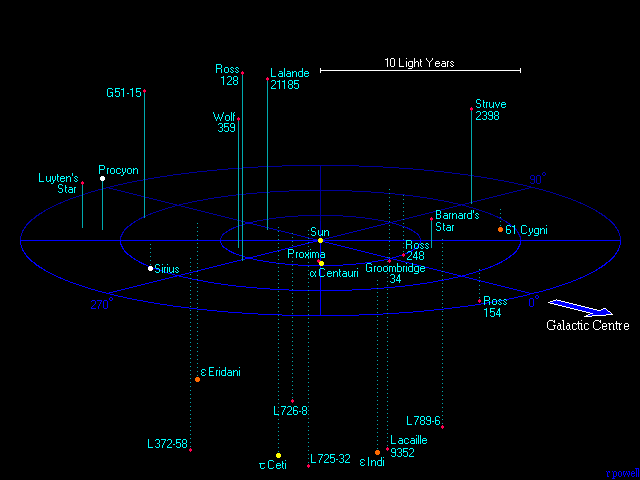
Here are our neighbors. We know them well. The numbers are distances in light years.
Here’s another:

Break out your 1954 red and cyan anaglyph glasses to enjoy this animated 3-D model of our neighbors inside a 14 light year radius.
Grasping the starting point (the Planck length)
To get a sense for the starting-product of the insane-making expansion, consider that the diameter of the average atom is 300 pm, or 0.3 nm (atomic diameter ranges from 0.06–0.6 nm). What’s that? The diameter of a low-energy hydrogen atom isn’t a natural unit for you? We can get their inferentially, by recursion: take something 3 mm in diameter (a sesame seed) and cut it into 10ths, pick one of fragments and then cut it into tenths … and repeat this process seven more times.
Here are some other examples of smallness to think about:
- A hydrogen atom is 0.025 nm in diameter, and the distance between the teeth of an X-ray saw blade is only 0.005 nm (5 pm), a fifth of a hydrogen atom. No wonder they scramble our DNA—it’s small enough to grab and knock hydrogen atoms.
- A gamma ray wavelength is a fifth of an X-ray’s, at 1 pm.
- Divide that into 100, and one of those is the average size of a nucleus (10 fm, or 10-14 m). A 10th of that is a proton (1 fm).
- Divide the diameter of a proton by 1000 to get a quark (1 am, or 10-18 m).
- Divide the diameter of a quark by 1000 to get a high-energy neutrino (1 zm, or 10-21 m). Divide that by another 1000 to get a normal one (1 ym or 10124).
- Finally, a 10-billionth of a ym is the granular minimum existent of space itself, the Planck length, at 10-35 m.
Grasping the brevity of the
Finally, to build your comprehension towards the frightening brevity of the insane out-popping, you would have to divide a second into 10ths, pick the first one, and then divide it into tenths (and so on) … 33 times.
Your total speed: 3,037,670 km/h plus the speed of space itself, which is greater than light relative to some distance places in this universe 93,000,000,000 light years across.)^